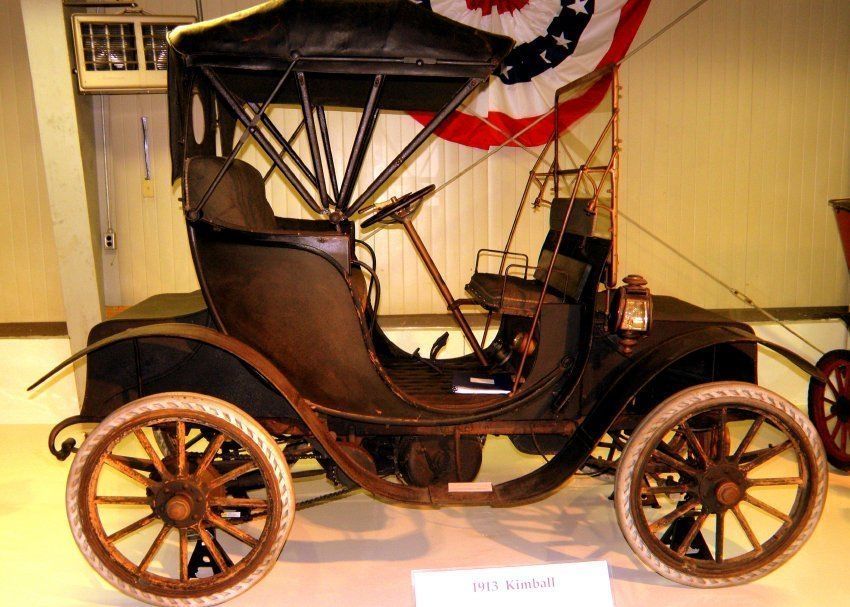
Kimball Electric 1913
Motor Vehicle
It appears that this very original car has a total of 33 hours on the motor and 2.5 hours on the last charge; this corresponds to the 297 total miles and 28.1 hours on the "trip odometer." this is an average of 9 MPH over the use of the vehicle. A recently acquired photo of the car on display in the 1950's is in the vehicle binder. The vehicle should be stabilized and preserved. The Kimball Electric Automobile lo was made by The C. P. Kimball & Co. in Chicago, Illinois from 1910 to 1913. This early Electric automobile was available in both two and four passenger versions. The General Electric motor model 1025E1SW operated on 60 volts, 32 amps and was rated at 10 horsepower with a practical limit of 1200rpms.. A full charge of the Exide battery rated 75 to 100 miles. The transverse motor drove the rear wheels by double chain, steering was by wheel and the car had solid rubber tires. Very few Kimball Electric cars were made and this is the only one known to exist. The C. P. Kimball & Co. was a major carriage maker in the late 1800s and early 1900s and was a Judge in the 1896 Chicago to Evanston Automobile Race. C. P. Kimball died in 1891 and was succeeded by his son Charles F. Kimball who promoted the idea of making carriages and Electric Automobile lug. Unfortunately Charles F. Kimball passed away from heart disease in 1909 and his younger brother, Charles Porter Kimball II, assumed the presidency of the firm. This is an un-restored black Victoria with worn faded black paint, black leather fenders, a black folding top with green tufted fabric upholstery, and wood spoked wheels with the remains of yellow paint. The brass lighting has been partially painted. This is the second vehicle that was donated by John Mozart. The appraiser (Locke) speculated that this is a late production special order car. There is extensive information on the Kimball family and on early electric vehicles on file in the vehicle binder.