Knox 1903
Motor Vehicle
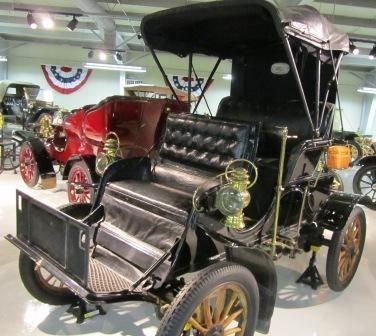
The Knox car, built in Springfield, MA, by Harry R. Knox was a bit different that most right from the start. The firm started out with a one-cylinder air-cooled engine which was in a very distinctive three-wheeled-tiller-steered chassis in 1900-1901. Knox soon moved to four wheels in 1902, along with a two-cylinder engine which was horizontal as the earlier one-cylinder was. The Knox cars were tiller driven until 1904, in 1905 they adopted a steering column and wheel, but it appears that they used the tiller column visible in front of the drivers arm, for other control functions. This car uses the style of hood which is seen in a 1907 catalog illustration, but could have possibly also have been used in 1906. The model F was offered in three different wheelbases during 1906 that ranged between 81" to 90" and in 1907 only as a 91" version. During both years the engines are listed as being rated at 14/16 h.p. Most makers of air-cooled engines utilized cooling fins which were usually cast integral with the cylinder block. At the time it was found this would only work for light duty engines, as it could not carry off heat fast enough under heavy loads. Harry Knox took it one step further and came up with the clever invention called pin-cooling. The illustration below shows his solution, where hundreds of specially made pins with a spiral-knurled surface which increased the surface area a reported 100%. The pins were threaded into holes which were drilled and tapped into the casting. According to the 1911 edition of Self-Propelled Vehicles, these pins which were machined out of brass round stock. The combination of the pins and a small mechanically-driven fan, kept the Knox engine running at normal engine temperatures. This pin-cooling lead to the air-cooled Knox engine acquiring the nickname, "The Porcupine engine". This is an older restored vehicle with a black body, gold pinstriping, black leather/Leatherette upholstery and top and wood spokes wheels. The car has a front fold-out seat and brass lighting and accessories.